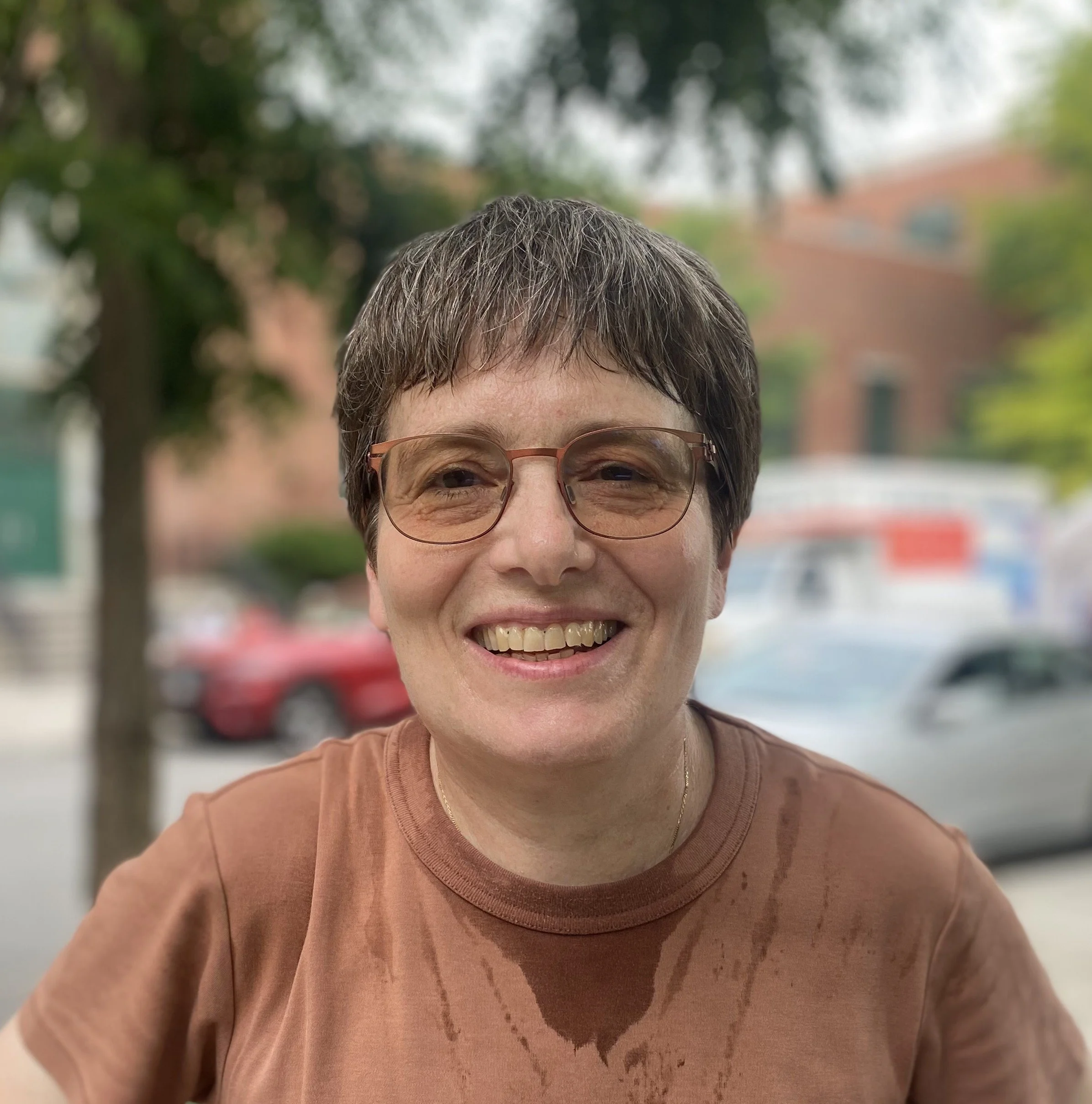
Photo by Mattie Branson-Meyer
Cathy Waterman Interview Transcript:
KRYSTAL: Hello, I am Krystal Lee, and I am here with:
CATHY: Cathy Waterman
KRYSTAL: At the Park Slope Old Timers Day at 4th street and 5th Avenue on Saturday, August 8, 2026. Can you please spell your name for me?
CATHY: C-A-T-H-Y W-A-T-E-R-M-A-N.
KRYSTAL: Thank you so much. So what is your relationship with Park Slope?
CATHY: So it was the first place my parents lived in– actually, the only place my parents lived in when they first came to this country. When my father came over, he was staying with some friends of his in downtown Brooklyn, but he needed a place because he knew he was going to bring my mother over. So he was, he liked to walk, and he was walking down Flatbush Avenue one day, and he happened to see 8th Avenue, and he says, oh, this looks nice. So he turns the corner, he's walking down the street, and he sees a sign in the window of an apartment that says to let. So he calls up about the apartment, but the landlady wouldn't rent to him because he was Jewish, so then his friend calls up and the landlady is like, oh, yes, the apartment is free, come on down. So the friend goes down with my father and says my father is his assistant, you know, and they look at the apartment and the friend says, okay, I'll take it. And the landlady pulls out the lease, but it was my father who signed it, and the landlady was enraged, but she ended up– she ended up getting along fine with my parents, so. And then we lived there– that was in 1964, and then we lived there– well, they lived there three years, and I was born there. And then in ‘67, we moved around the corner to Carroll Street, and then I moved to Union street in ‘75 with my mother, and I'm still there.
KRYSTAL: Wow, so you're still in Park Slope?
CATHY: I'm still in Park Slope. I got a good story about the move to Carroll Street.
KRYSTAL: Okay, please share.
CATHY: So my parents were renting a furnished studio. Oh, my parents were renting a furnished studio, you know, so when we moved, they didn't really own any furniture, and they didn't really have anything because they'd come over just with suitcases, you know. So my father moved all of our worldly belongings in the– in the baby buggy around the corner to our new apartment. You know, baby buggies were like big things in those days, so he just piled, like, the clothes and the kitchen stuff, and that was it. We moved everything in the baby buggy, and that's how people moved in park slope in 1967.
KRYSTAL: Wow.
CATHY: So, we still needed furniture, so in those days, you know, moving was expensive, but secondhand furniture was cheap, so if people moved, they would just sell their furniture and then buy new secondhand furniture, so my mother, like, bought some stuff off our neighbors who were moving away, and then she went to, like, secondhand stores and got secondhand furniture, and that was Park Slope back in the day.
KRYSTAL: Very nice, wow. Sounds like you have a lot of old memories.
CATHY: I do.
KRYSTAL: Very good, thank you so much for sharing. Do you have– I know that you just told us one of your fondest memories that you have with Parks Slope, but do you have a particular powerful memory of Parks Slope?
CATHY: Well, I would say, I mean, it was a great place to grow up because, like, you know, you walked outside, there was always kids. I mean, very few people owned a car, so there wasn't much traffic, so you could just play in the streets. This was in the 60s, 70s, and you could just play in the streets all day. My brother used to play stickball– that was a boys game, so I played stoopball– but you could just walk outside and there was always kids, you know, and like, maybe it was where I learned to be an American because, you know, we spoke my mother's language at home and it was her culture, but you walked outside and there was kids from like every kind of backgrounds, you know, and it was great, a lot of families, it was great. It was really a good place to grow up.
KRYSTAL: It sounds like a fun place.
CATHY: I did have fun, yeah.
KRYSTAL: Why did you decide to come to the Parks Slope Old Timers Day today?
CATHY: I thought maybe I'd find somebody I knew.
KRYSTAL: Did you meet anybody?
CATHY: No, but I think there's not a lot of people left.
KRYSTAL: But you told me that you still live in Park Slope.
CATHY: I do.
KRYSTAL: Okay, so meaning that you still live in Park Slope, do you still have relationships with anybody that you grew up with in Park Slope?
CATHY: Yes, I'm still in touch with a couple people I was at PS321 with, but they're not here anymore. It's me that's here. But, I mean–
KRYSTAL: They've moved to a different state, a different country?
CATHY: Yeah, no, they're in different states now.
KRYSTAL: Okay. Yeah, well, by all means, please invite them out, okay? Because we have people that travel from near and far to come out to this event.
CATHY: Yeah.
KRYSTAL: It's always, it always takes place on the second Saturday of August. No matter the date, it's the second Saturday of August. So by all means, feel free to invite more people that you know so that this, this, this event could continue to grow.
CATHY: Okay.
KRYSTAL: Okay? What are some things you think more people should know about Park Slope based on your experience?
CATHY: Based on my experience? I mean, back in the day, it was a really great place to grow up. I mean, when the neighborhood started changing in the 80s and becoming like more wealthy, there were like a lot of stories that, oh, this was like such a terrible area, and it was like people who came in who saved it. But, I mean, this was a really good place to grow up. A lot of families, a lot of kids, I mean, and I think people looked after each other more than they do now.
KRYSTAL: So that's what I'm hearing across the board through a lot of the people that I interview, it was more of like a family oriented community?
CATHY: I would say so, yes.
KRYSTAL: Where everybody looked out for each other.
CATHY: I would say that, yes.
KRYSTAL: You grew up with your friends that eventually turned family.
CATHY: Yeah.
KRYSTAL: So, yeah. Sounds like a wonderful place to grow up. What are your hopes for the future? And when I ask this question, if it could come from a perspective of somebody that's still living in Park Slope, that's seen it changed over the years: what are your hopes for the future for your neighborhood now and your neighborhood then?
CATHY: Well, I mean, I don't have high hopes for this, but it would be nice if Park Slope could be affordable again to people coming up now who are like my parents, you know, like lower middle-class immigrants who are just looking to make a life, you know. But I don't have high hopes that that would be possible because you need a lot of money to be in–to move into Park Slope today. I mean, and I don't, realistically, I don't see that changing. I mean, it would be nice, but I don't see that changing, so, I mean, it would be sort of a wishful hope, maybe. It would be nice if it was like, it was much more diverse back in the day, you know, I mean, I grew up among kids from, like, every kind of background, and I don't really see that today, and I think that's a big loss. I think that's a big loss.
KRYSTAL: And that stems from the cost of living in Park Slope.
CATHY: I think so, yeah.
KRYSTAL: Absolutely.
CATHY: Yeah, yeah, yeah. You need a lot of money to be here now. Yeah.
KRYSTAL: Well, listen, your hopes for the future of your community is still valid despite your standpoint of how things may change or, you know, where you see things standing right now is still valid, so thank you so much for sharing. Thank you for sitting with me, and have a great day.
CATHY: Thank you.