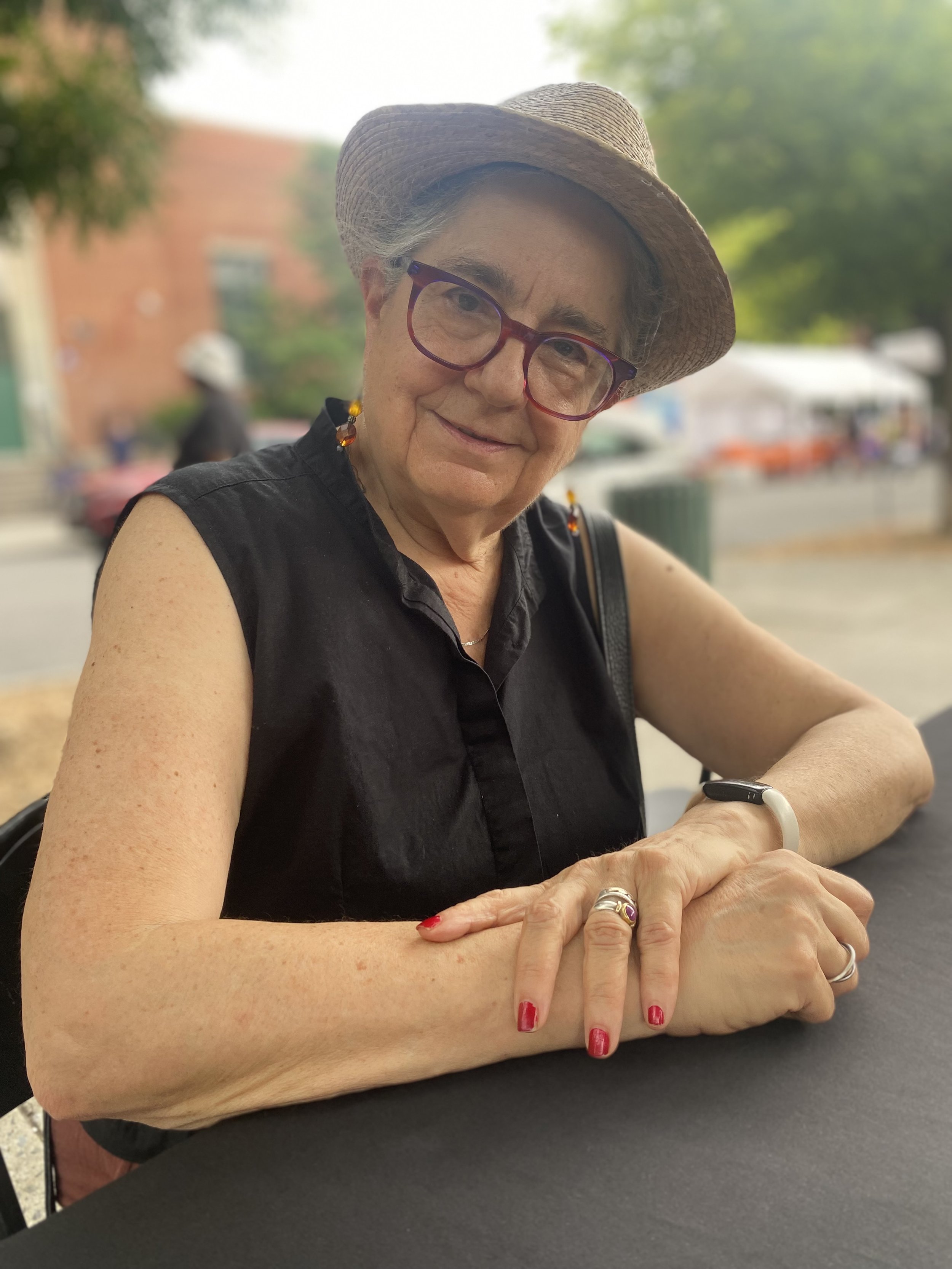
Photo by Mattie Branson-Meyer
Anne Lipke Interview Transcript:
KRYSTAL: Hello, I am Krystal Lee. I am here with:
ANNE: Anne Lipke
KRYSTAL: At the Park Slope Old Timers Day at 4th street and 5th Avenue on Saturday, August 8, 2026. Can you please spell your name for me?
ANNE: Anne, A-N-N-E. And the last name is Lipke: L-I,-P, as in Peter, K-E.
KRYSTAL: What is your relationship with Park Slope?
ANNE: Well, we moved here in 1978, and we stayed up on 7th Avenue for a little less than a year and bought a house on 6th Street, and we looked at a house on 4th street and actually thought it was beautiful, but it was a little too beautiful, it was out of our price range.
KRYSTAL: I get it, I get it.
ANNE: It was one of the first renovated houses. It was owned by a white couple. I think they were uncomfortable at that point in the neighborhood, but we would have loved it because we were a multiracial family.
KRYSTAL: Okay. So you told me that you didn't grow up in Park Slope, but you raised your kids in Park Slope.
ANNE: Yes, we did.
KRYSTAL: What was it like for you raising your children in Park Slope?
ANNE: It was really wonderful. It was fabulous. They started out at P.S. 39.They ended up at Junior High School 51s. That's with an S! When we went to 51s, they did not have anybody who lived above Fifth Avenue, they sent everybody to 88. They had an annex where the people of color were and the main building was for white kids. When we came here, Mr. Schaefer was principal over here at 51s, he would…he took no nonsense. And there were drug dealers in the park. He was an ex-Marine, he would come out and chase them during the school day so they wouldn't affect the kids here. And my oldest son– we got 11– he was Black-Korean, so he spoke Korean, but he looked Dominican. People come up, speak Spanish to him and he’d say I don't even know English. He was in the English as a Second Language. Mr. Rosen was the principal. He really made friends here. Then it became the gifted program– Mr. Schaefer started that. The first year, I think one white kid signed up for it. Our Korean, full Korean son joined– very, very bright kid. Mr. Schaefer taught a course on World War II. They really related, and his first assignment was to write “What do you know about World War II?” He handed in three pages. Remember, this is what, sixth grade, seventh grade, and there was announcement: Mr. Schaefer wants David Lipke to come to the office. So he's walking to the office, and the school safety officer is like, “what are you doing in the halls?” “We're going to Mr. Shaefer's.” “Okay, I'm taking you.” And he goes in, and Schaefer opens up, like, to the second page and points to David, says, “who was that?” “Oh, he was a German general in North Africa…” And he goes “Okay, kid.”
KRYSTAL: So he was very bright. He knew a lot about the wars, the world wars.
ANNE: Yeah, he actually skipped the last year at P.S. 39. We realized that the adoption agency probably made him younger than he really was, because a lot of people won't adopt kids over 5. So they told us he was just under 5, but we think he was closer to 6. So we were actually putting him in with his grade level, and Mr. Yermak was principal at 39, and he said–I thought he'd give me a hard time about him skipping– and he said gosh, we should have had him skipped last year, he's missing all the senior things. But at graduation, he let him play the piano so he could be with the other kids. Just, everybody was very, very supportive. And then Schlar came in, and he wasn't so supportive.
KRYSTAL: Sounds like it was a dream for you to raise your kids in a community where, you know, the teachers were supportive, the principals were supportive, and they were able to see your son for who he was.
ANNE: They could walk to the library, they could walk to Prospect Park, they could take the subway. So we– the one who was younger, the one that was younger, he was learning disabled, so I took him up to Hunter College in fifth grade, and then his dad, who was working there would bring him back. In sixth grade he was like, I'm old enough to do this by myself. So, they had a lot of freedom here. Oh, and we were here long enough that the kids still played street games. What's the one with the bottle caps with the wax in it? Scalesies. You make a… They would do that, and they played– there was an oil truck place across the street, and that's where they play ball, so the ball would hit the gate in the back. And we found out our window was plastic because the kids broke so many windows to the house.
KRYSTAL: Wow wow.
ANNE: And the rule on the block was that if they broke a window, all the kids had to chip in.
KRYSTAL: Really?
ANNE: Yes.
KRYSTAL: What was it the kids that had to chip in or the parents?
ANNE: Well, in our house, the kids, they had to do extra chores.
KRYSTAL: I get you, I get you. So this one– this question is more like regarding yourself. Do you have a particular powerful or important memory of Park Slope?
ANNE: I have a good memory.
KRYSTAL: Please share.
ANNE: Yes. Plane goes by [plane flying overhead]. Because it’s– our block was heavily Italian, the grandmothers would lean out the window and look. And the electricity used to be more expensive in the summer, so a lot of people didn't have air conditioning, or they wouldn't run it. In the evening we’d all sit on our stoops, but the middle child was sort of shy and he was going down the block, and one of the kids, who was younger but big, my oldest son hit. And one grandmother was like, you shouldn't be hitting him, you're too big. And the other grandmother said he was bothering his brother. She said, oh, okay. So everybody sort of looked out, and also the oldest one's bike was stolen, and my Italian neighbors brought over an old bike and said, let him use this one. So it was really, people– we were a little nervous because we were bringing a Black kid into the block. But they, they looked out for him. We had no problems.
KRYSTAL: Wow.
ANNE: Yeah, o just that's how I felt about the block, we had block parties in those days. We don't anymore. We had Christmas wreaths one year they put up, then every– some of them got stolen. But we, it was a real community. It's still a community, but just not as many people are as active.
KRYSTAL: Okay.
ANNE: Yeah.
KRYSTAL: And it's not as united as it was before, it sounds like.
ANNE: No, no. They just sold– they took the old tinsmith on our block, converted it into two condominiums. They were three and a half million dollars, and the other one was $4.1 million. And we met the person and her question is, is this block safe? I said, yes. But, but like, we have neighbors now, we're very close to, and they could afford to move in. They got, one's Chinese, the other is Irish. They have three kids. But they were able to buy the house because they inherited another house that they could sell to move in. So we still get some family, but it's not the way it used to be. No more Scalesie.
KRYSTAL: No more street gangs, right?
ANNE: Oh, well, we did have drugs being sold on the block. And at one end they sold marijuana, at the other, at the other they had more expensive drugs. And I have to say that's, when they tore down the gas station to build a condominium the drug dealers left, they didn't like the noise.
KRYSTAL: So maybe that's one reason why the community had to change, right? That and I'm almost sure and positive that many other reasons contributed to the community having to change.
ANNE: Well, it got, people decided that it was a great place to live. When we moved in, it was right after Ford said New York City, drop dead. And they also– I mean, we moved in because we knew the schools were good here, but that got more and more common. Brooklyn Tech, one of my kids went to Brooklyn Tech, one of– my wife's son, and I ran into people who said, oh, we can't send our kids there because there are too many, you know, of those people there. And I felt like saying we have those people at home, too. But we watched– Tech was written up in Ebony magazine as a good place for African American kids when he was there, And now the percentage– we're not as bad as Stuyvesant, but the percentage is much different. Was much, much, much more diverse when he was there. And he had–
KRYSTAL: It was a specialized high school, right?
ANNE: Yeah, but it was the vocational of the specialized schools. That was A) and B) people didn't like the neighborhood. You know, Spike Lee lived there, so it wasn't exactly, you know, dangerous.
KRYSTAL: Right, right, I totally get what you're saying. So my next question is, why did you decide to come to the Park Slope Old Timers Day today?
ANNE: We do a lot of stuff at the Old Stone House and we saw it mentioned and we didn't have a clue what it was, but we wanted to get out and walk around.
KRYSTAL: Well, thank you for your interest and thank you for coming by. I look forward to seeing you next year.
ANNE: Oh, that'd be great.
KRYSTAL: So what are your future hopes for the neighborhood?
ANNE: I hope that people who live here, like their kids can still live here, that we get some of the old timers able to stay. We have a son who lives–we're a multi-fam– you know, three family house. Our son lives on the top floor. We have had tenants who've been there over 20 years and it's, it's hard. It's hard for people to be afforded to stay here. But, I hope, like my neighbors who've moved in, I mean, I hope they're here forever. I love their kids, I love them. We're close and I would like to have more people like that. The house on the other side, guy bought it, flipped it, thought he could sell it for a lot of money, hasn't been able to, so we have some nice people renting, but it doesn't feel permanent. Where do you live?
KRYSTAL: I want to thank you for sitting with me today. I am going to get to your question a little offline though.
ANNE: Okay.
KRYSTAL: I want to thank you for sitting with me today and completing your interview. Have a great day.
ANNE: Thank you.