Mark Aubert Interview 08/09/2025
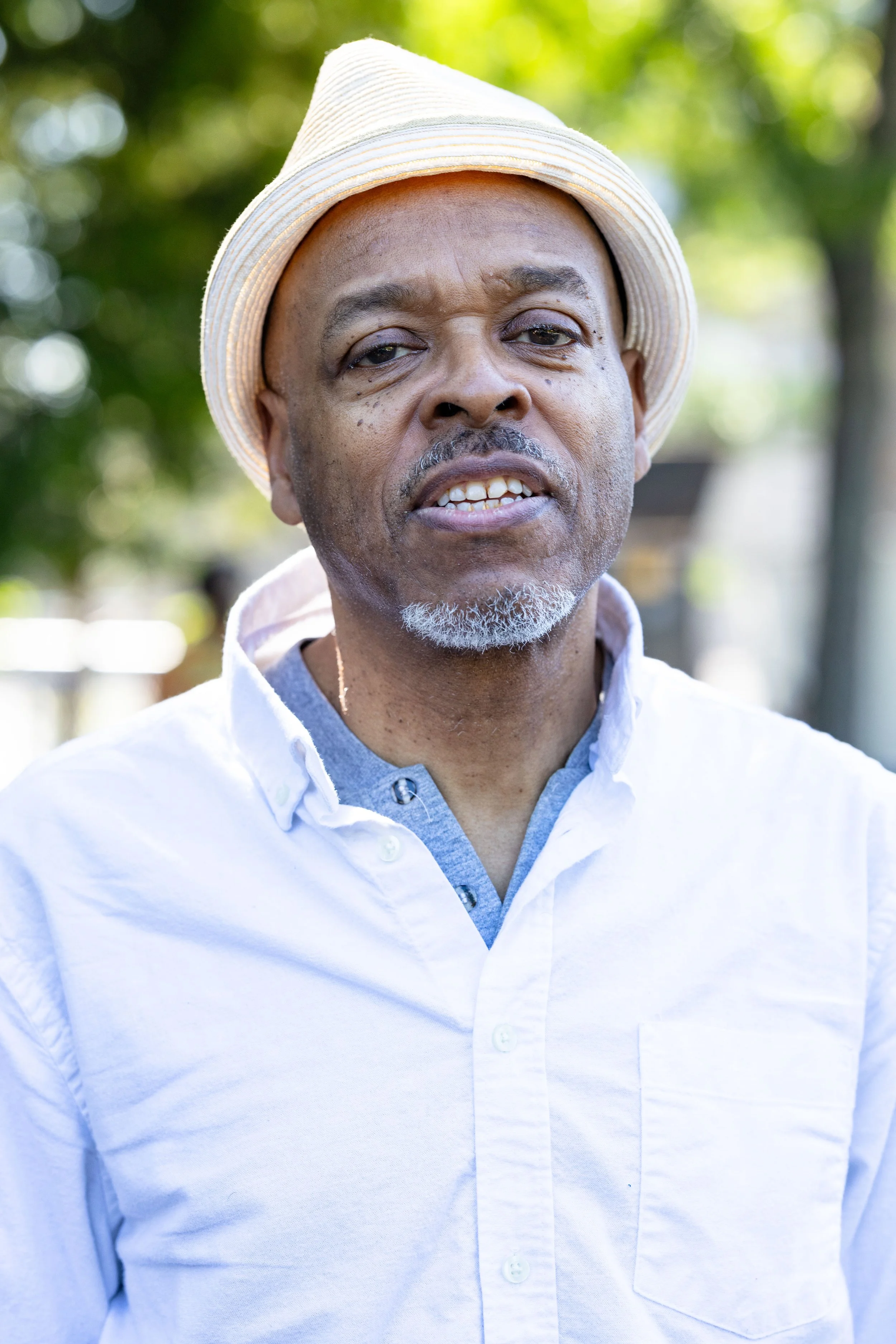
Photo by Randi Rosenbaum
Mark Aubert Interview Transcript:
NATASHA: Hello, I am Natasha Fearon and I'm here with Mark Aubert at the Park Slope Old Timers Reunion at 4th Street and 6th Avenue on Saturday, August 9th, 2025. Please spell your name.
MARK: 5th Avenue, you said 6th Avenue.
NATASHA: Can you spell your name for me, please, sir?
MARK: M-A-R-K A-U-B-E-R-T.
NATASHA: What is your relationship to Park Slope or to Brooklyn?
MARK: I wasn't born here, but we moved, we moved in Park Slope like around, I wanna say like, ‘60, ‘62. But we wasn't living over here. We were living further north. We were living on St. Mark's between 4th and 5th Avenue. And we lived there for like a number of years and then we moved over here to 4th Street between 5th and 6th Avenue.
NATASHA: Do you have a particular powerful or important memory of Park Slope or Brooklyn you'd like to share?
MARK: What I mostly remember was the block party. We used to have some good black parties on 4th Street, but one of the best block parties I went to was on 3rd Street between 6th and 7th Avenue. It was really good.
NATASHA: Why did you decide to come to the Park Slope Old Timers Reunion today?
MARK: These are people I knew when I was a child. I went to the first one and it was really great. I've seen people who I hadn't seen in like over 50 years. So that's what brought me out.
NATASHA: What are some things you think more people should know about Park Slope or Brooklyn based on your own experience?
MARK: This is um…Wow. There's things that I see now that are much... With gentrification came a lot of changes. And not just in terms of just... the Black folks who lived here, but even the whites. It was a different kind of demographic of white folks that lived here. And we used to, you know, it was a lot of Italians and Irish. And there was a lot of, back when I was living here, there was a lot of racial friction between us. In fact, when I was living here, I remember three race riots here in this neighborhood. And one of them, I don't know if you know Michael Cason. He had a brother named Leon. And he got stabbed right on the corner of 4th Street and 5th Avenue, and I don't like to talk about negative stuff, but I'm just saying that this is the kind of stuff that was going on. And it sparked a riot. And so... With gentrification, that kind of stuff wasn’t happening really anymore. But what happened is that it displaced a lot of people who had been here for a long time. It changed the color of the neighborhood in terms of... It became less flavorful. The neighborhood had a lot of flavor. That's why I'm saying, like the block parties. I remember like during the summertime, this place was popping. And it just doesn't happen like that anymore. I don’t see, I don't feel it. I don't feel it like how it was before. I don't know if you want to put this on your website.
NATASHA: What are your hopes for the future of the neighborhood and Brooklyn?
MARK: Of this neighborhood?
NATASHA: Mmhmm– and/or Brooklyn?
MARK: My hope, and it's not just for this neighborhood, it's for New York in general, that it becomes a more friendly place for working class and even poor people. You know, it's really, it's becoming less and less that. You know the older I get. I live in, I currently live, I've been living in Harlem for the last 40 something years, and I see the same thing happening over there. It's also because, it's become more gentrified and like I said with gentrification there are some benefits to it: the neighborhood does look nicer, it's a lot more friendly, but it’s not…the roughest thing about living in New York now is paying rent and being able to feed your family, feed yourself and feed your family. That would be my hope, that it would be more inclusive of people who fit in that demographic of working class and poor people. 'Cause it's a much, it becomes much more dynamic in terms of this scope. In terms of the scope and the kind of people who contribute to the overall culture of this place.
SPEAKER: There was a restaurant right on the corner at Fifth Avenue and 4th Street. They would sell you a hamburger 2 for a quarter.
NATASHA: Thank you.
MARK: Oh, right there. I remember that.
SPEAKER: They will sell you one for 15 cents.
MARK: Fifteen cents, I remember that restaurant.